Web Search
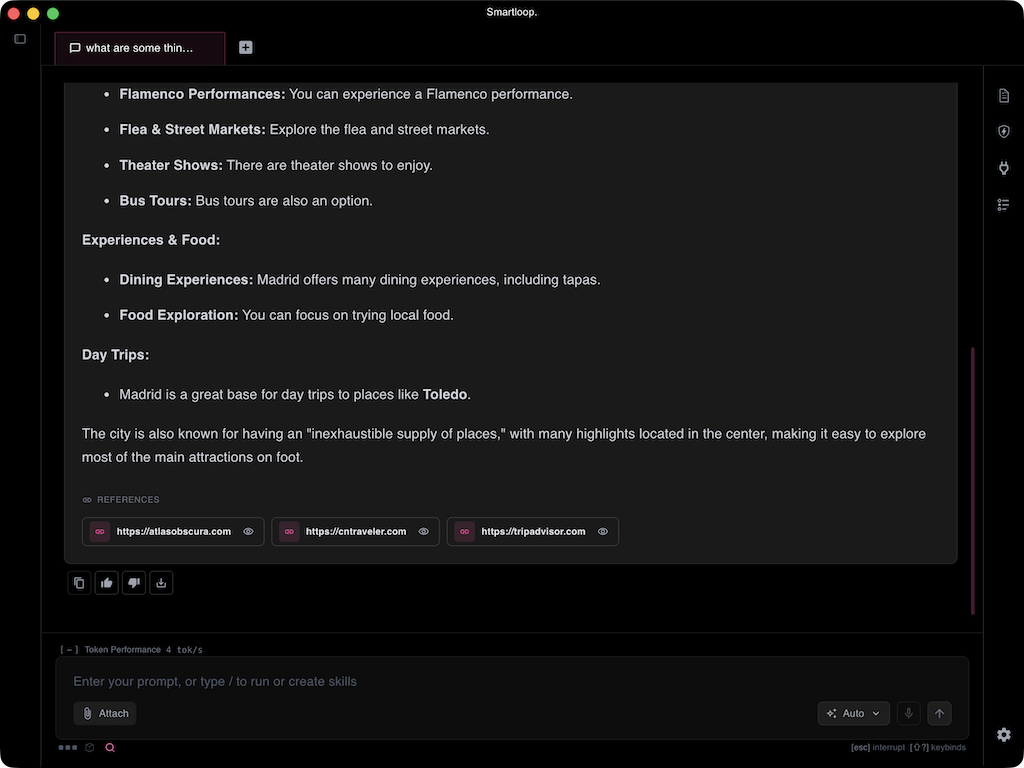
AI search lets a project reach current information from the web, so answers reflect the latest data rather than only the model's training data and the documents you have indexed locally. Search in Smartloop is hybrid: the web is used only to find pages relevant to your question, and everything else — reading your prompt and attachments, ranking the pages, and writing the answer — runs on local models on your device. Every answer that used search is annotated with the sites it drew from.
Getting Started
There is nothing to set up and no API key to sign up for. Searches are proxied through Smartloop, so web search works as soon as you are signed in — on every device, with no per-machine configuration.
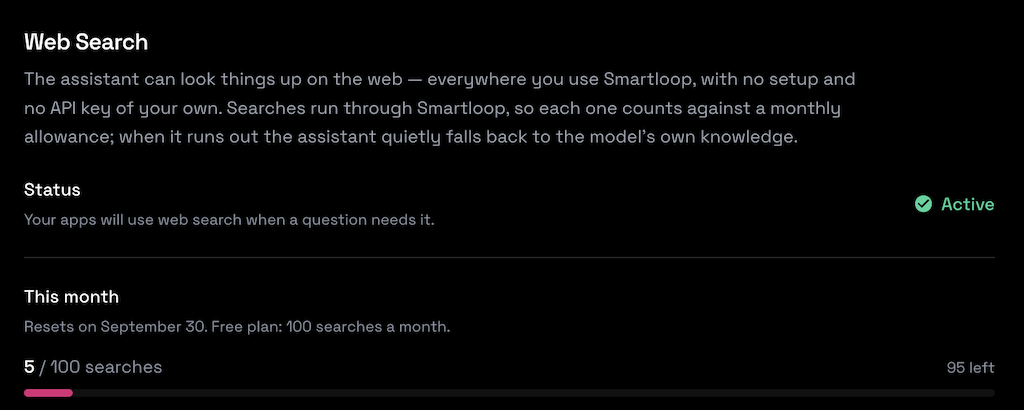
Search is the one metered part of Smartloop: every account gets a monthly allowance of searches, and Pro is $5 a month for 1,000. Everything else — the models, your documents, tools and skills — stays free and runs on your machine. See Pricing for what each plan includes.
Hybrid search
In a fully cloud AI search product, your prompt, any attachments, and the surrounding context are sent to a hosted model, which searches, reads the results, and writes the answer on the provider's servers. Smartloop splits that work: the only thing that goes out is the search query, and the heavy lifting stays on your machine.
| Step | Where it runs |
|---|---|
| Reading your prompt and any attached image or document | On your device |
| Deciding which tools the question needs | On your device |
| Finding result links for the query | Smartloop's search endpoint — the query only |
| Fetching and ranking the candidate pages | On your device |
| Writing the answer from the top sources | On your device |
The local steps are not one large model doing everything. Each sub-task is assigned to a model suited to it — a vision model reads an attached photo, a small model picks the tools, and another writes the response — which is how the whole flow fits on an ordinary laptop. See Model orchestration for how models are chosen.
For example, attach a photo of a device and ask where to buy it and what it costs. The photo is understood on your device, a query goes out, the most relevant store and review pages are read locally, and the answer comes back with those pages listed as references. The photo itself never leaves your machine.
Combining your data
Search is most useful alongside your own data rather than instead of it. Because a project already holds your documents, one prompt can draw on both — your documents for context, the web for what is current.
Product research is a good example. With your existing gear, specifications, or past purchases in the project, you can ask what to buy next: the assistant reads your documents to understand what you already own and what would fit, searches for current models, pricing, and reviews, and then recommends one — with the sites behind the recommendation listed underneath.

Annotated sources
When an answer draws on search results, the sources used are listed in a REFERENCES block beneath it. Web sources link out to the original page, so you can confirm where a claim came from and read further. Documents from your own project appear in the same block, labelled by file type and openable directly — so it is clear at a glance which parts of an answer came from your files and which came from the web.
How it works
- Local models read your prompt and any attachments — an image goes to a vision model — and decide whether the question needs search.
- Your prompt is normalized into a search query — conversational filler such as "can you tell me" is stripped so the query matches the actual subject rather than the phrasing.
- The query goes to Smartloop's search endpoint, which returns result links. This is the only step that leaves your machine.
- Up to ten candidate pages are fetched and converted to text on your device (HTML and PDF are both handled).
- The candidates are re-ranked by relevance to your question, and the top three are kept as sources for the answer.
- A local model writes the answer from those sources and lists them under REFERENCES.
If search is unavailable for any reason — turned off for the project, this month's allowance used up, or no results — it is skipped silently and the model answers from what it already knows. You will see an answer without a REFERENCES block rather than an error.
Privacy
Search is the one part of Smartloop that reaches off your machine, and only the query leaves it. You can turn off search from Project Settings.
Smartloop does not keep the query. Your account records only that a search ran — when, from which app, and how many results came back — so you can spot use you do not recognize in your own activity log. The wording, the results, and the pages behind them are never stored. The candidate pages are fetched and ranked on your device, so the sites you end up reading are not something we see either.
The only number we keep is the count itself, which is what the monthly allowance is measured against.
Checking your usage
Web search is on by default. You can see whether it is active, how many of your month's searches you have used, and when the count resets at app.smartloop.ai/settings/websearch.
Within a project, the toggle under the prompt (⌘⌥S, or Ctrl+Alt+S) turns search on and off for that project.
Summary
AI search in Smartloop is hybrid: the web supplies fresh, relevant pages, and local models do the rest — understanding your prompt and attachments, ranking the pages, and writing the answer. Your models, documents, and attachments stay on your device, and only the search query leaves it. The annotated references make it clear which parts of an answer came from the web.